Best Excel Tutorial

Excel Skills Simplified: Tutorials That Actually Work

Copy and Paste in Excel: Master Every Technique from Basic to Advanced

Copy and paste is the most fundamental Excel operation. You use it constantly to duplicate data, replicate formulas, move information, or back up important content. While the basic operation is simple—Ctrl+C to copy, Ctrl+V to paste—the depth of functionality is surprising. Understanding different paste options transforms copy/paste from a simple duplication tool into a powerful data manipulation technique.

The standard copy/paste operation is straightforward: select cells, press Ctrl+C to copy, navigate to the destination, press Ctrl+V to paste. The cells replicate at the new location. If you’re copying formulas, Excel adjusts cell references automatically (relative references shift; absolute references stay the same). If you’re copying values, the exact numbers or text appears at the destination. This basic operation handles 80% of copy/paste needs, but the remaining 20% requires understanding paste options.
Read More

Understanding Excel Cells, Rows and Columns: The Foundation of Everything

Every Excel spreadsheet is a grid made up of cells organized into rows and columns. This grid structure is so fundamental that understanding it is prerequisite to everything else you’ll do in Excel. You can’t enter data without knowing which cell you’re in. You can’t write formulas without understanding how cells are addressed. You can’t select ranges without grasping rows and columns.
Get this right at the start and every subsequent skill becomes intuitive. Misunderstand it and confusion compounds as you learn more.

Read More

How to Use AutoSum in Excel to Calculate Totals

Adding up columns or rows of numbers is probably the most common task in any spreadsheet. You could type out formulas manually, but Excel’s AutoSum feature does the work for you in one click. AutoSum looks at your data, figures out what you want to add, and inserts the correct formula automatically. For anyone working with numbers regularly, AutoSum saves hours of
repetitive formula entry.

Think of AutoSum as Excel’s smart assistant for math. You’re working on a budget and you need the total of your monthly expenses. Without AutoSum, you’d type =SUM, then carefully select each cell, then close the parentheses. With AutoSum, you click one button and Excel handles all of it. The feature isn’t just for addition either. AutoSum can quickly insert AVERAGE, COUNT, MAX, and MIN functions too, making it a versatile tool for basic calculations.

Beginners often overlook AutoSum because they’re focused on learning complex formulas. But professionals use AutoSum constantly precisely because it’s fast. When you’re working through financial reports or sales data, AutoSum eliminates the tedious parts of formula writing and lets you focus on analysis. Getting comfortable with AutoSum is one of those small skills that
delivers daily time savings.

Read More

How to Divide in Excel

Division in Excel is as simple as using the forward slash operator. Type =10/2 and Excel returns 5. Type =A1/B1 and Excel divides whatever is in A1 by whatever is in B1. The basic operation is straightforward, but understanding how to use division effectively across spreadsheets, handle errors gracefully, and format results properly transforms division from a simple calculation
into a powerful analytical tool.

Division appears constantly in spreadsheet work. You divide total expenses by number of months to get average monthly spending. You divide revenue by number of units sold to get revenue per unit. You divide budgeted amount by actual amount to calculate the percentage of budget used. You divide total sales by number of salespeople to get average sales per person. These practical calculations drive business decisions. Getting division right matters.

The challenge with division is that it can fail. Dividing by zero produces an error. Dividing cells containing text produces an error. Dividing very large numbers by very small numbers can produce unexpected results. Understanding these edge cases and how to handle them prevents errors and builds confidence in your formulas.

Read More

How To Use Excel Formulas

Formulas transform Excel from a static grid into a living calculator that updates automatically as your data changes. Type numbers into cells and they just sit there. Write formulas that reference those cells and suddenly you have a system that responds intelligently to any update. This responsiveness is why Excel dominates spreadsheet work it’s not just storage, it’s active calculation.

Every formula starts with an equals sign. This tells Excel you’re entering a calculation, not plain text or numbers. Without the equals sign, Excel treats whatever you type as text. Type 2+2 into a cell and Excel shows exactly that: the text “2+2”. Type =2+2 and Excel calculates it, displaying 4. That equals sign is the trigger for Excel’s calculation engine.

Formulas can be as simple as adding two numbers or as complex as nested functions with multiple conditions. This article covers the basics: arithmetic operators, how to reference cells, and simple calculations. These building blocks underpin everything more advanced you’ll learn later. Get comfortable with basic formulas and you’ve unlocked Excel’s true power.

Read More

How to Combine Two Columns in Excel: Concatenation Methods Explained

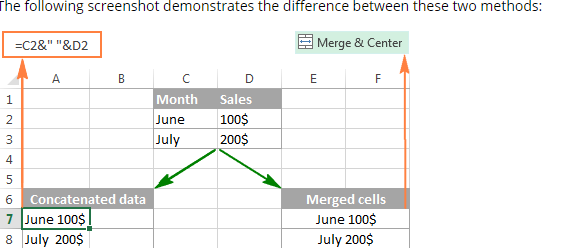
Combining two columns means joining text or values from one column with text or values from another column. You might combine first name and last name into a full name. You might combine street address, city, and state into a complete address. You might combine product code, product name, and product version into a complete product identifier. Excel provides multiple methods to concatenate columns, each useful in different situations.

The fundamental operation is combining strings (text). If A2 contains “John” and B2 contains “Smith”, you want to combine them into “John Smith” in column C. The combining happens in a formula that joins the values with an optional separator (in this case, a space). Excel treats this operation as string concatenation, joining text values together.

The most important concept: concatenation creates a new value that combines source values. If you later change the source (John becomes Jonathan), the combined value does not automatically update. This is different from formulas that calculate based on other cells. Concatenation is a one-time joining of values. Understanding this distinction prevents confusion.

Read More